
Intelligent Character Recognition
AI-powered ICR: Reliable Data Capture beyond Basic OCR
Step up your data capture workflows using our advanced ICR engine. Turn complex handwritten and printed content into structured, actionable data with high accuracy and minimal manual oversight.
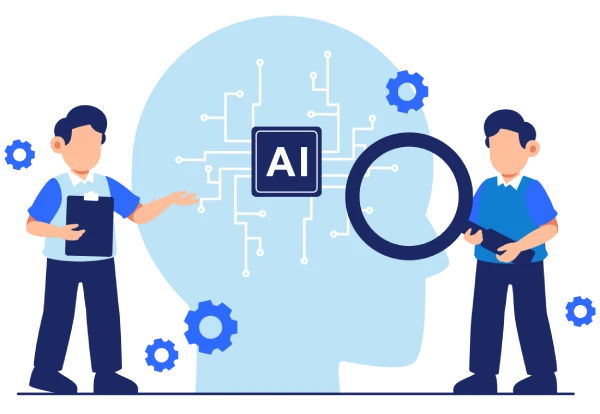
Intelligent ICR That Captures Data from ANY Text, Printed or Handwritten Docs
Our ICR engine merges classical OCR techniques with deep learning, neural models, and contextual analysis to deliver intelligent character recognition across diverse formats. The model is extensively trained to handle messy handwriting, mixed (printed and cursive) content, low-quality scans, and varied templates with ease.
Where standard OCR struggles, AI-powered ICR adapts and learns. This makes it ideal for extracting data from unstructured documents, forms, and letters, not just clean printed text.
We designed this ICR solution to:
What Sets Our ICR System Apart?
Superior Accuracy on Handwritten Documents
Hybrid Intelligence
Scalable & Modular
Customizable Training
Active Learning & Human-in-the-Loop
Seamless Migration from OCR
What Makes Our ICR Better Than Traditional OCR?
| Feature | Basic OCR | Our ICR |
|---|---|---|
| Text Types | Printed fonts, standard templates | Printed + Handwritten + Mixed, freeform |
| Template Dependency | High (zone templates, fixed layouts) | Minimal; can generalize across document types |
| Adaptation to New Styles | Very limited | Learns dynamically from new data |
| Context Understanding | None or weak | Capable of resolving ambiguous characters, using the context |
| Error Handling | Static | Flags discrepancies, allows review + feedback loop |
| Language & Script Flexibility | Fixed to pre-trained fonts | Flexible multilingual, mixed-script |
| Handwriting Recognition | Not reliable | Core strength as it can handle cursive, sloppy, freeform |
See How Data Capture Automation Can Revolutionize Your Documents
How Our ICR Works
1
Image Capture & Preprocessing
The ingested document is processed: clean up skew, remove noise, normalize contrast, and correct distortions.
2
Segmentation & Layout Analysis
The intelligent engine then detects lines, words, and character zones; trying to understand document structure.
3
Character Recognition & Contextual Inference
Neural networks recognize each character, and a context engine helps resolve ambiguities.
4
Post-processing & Feedback Loop
Spellcheck and domain rules (e.g. date formats). Uncertain items are flagged, corrected, and fed back to the model.
5
Data Output & Integration
Export structured data (JSON, XML, database) and integrate with your downstream systems or business logic.
6
Continuous Learning & Refinement
Every verified output is used by the ICR engine to learn and adapt to new handwriting styles and document types.
Real-world Use Cases for ICR
Handwritten Forms & Surveys
Insurance Claims Documents
Medical / Clinical Records
Banking & Finance
Legal Documents & Contracts
Education & Assessments
Experience the Transformation

Harness the next generation of document AI with Intelligent Character Recognition.
Related Posts

Interoperability in Healthcare Data Exchange
The Healthcare Information and Management Systems Society (HIMSS) defines interoperability in healthcare data exchange as "the ability of different information systems, devices, and applications to access, exchange, and cooperatively use data in a coordinated manner,...
AI for Fraud Prevention & Ensuring Compliance in Legal & Enterprise Document Review
Did you know? According to this Trans Union report, organizations worldwide lost 7.7% of equivalent annual revenue to fraud last year, representing a whopping $534 billion across the 1,200 business leaders surveyed. In a world where the volume of enterprise and legal...
Automating Personal Injury Case Reviews with AI
Did you know that 37% of personal-injury professionals personally use Generative AI in their work, and nearly one in five PI firms has already adopted legal-specific AI tools? If that stat entices you, good—because it perfectly encapsulates the reality: personal...