
The Healthcare Information and Management Systems Society (HIMSS) defines interoperability in healthcare data exchange as “the ability of different information systems, devices, and applications to access, exchange, and cooperatively use data in a coordinated manner, within and across organizational, regional, and national boundaries, to provide timely and seamless portability of information and optimize the health of individuals and populations globally.”
Data is generated today much more than ever before—electronic health records (EHRs), doctor prescriptions, imaging files, lab reports, wearable device data, claims data, genomics, and patient-generated information. Nevertheless, there is one big challenge that continues to undermine the promise of digital healthcare: lack of healthcare data interoperability.
The inability of health systems to seamlessly share and interpret data leads to clinicians having incomplete information, which in turn results in patients suffering from fragmented care and organizations incurring unnecessary costs.
In this post, we will explore what interoperability in healthcare data exchange really means, why it matters, the different levels of interoperability, key standards and technologies, challenges, and how emerging technologies like AI and blockchain are shaping the future.
Why Interoperability Is Important in Healthcare
True interoperability ensures that:
- Patient data flows securely across systems.
- Information is understandable and usable by receiving systems.
- Data supports clinical decision-making and continuity of care.
In simple terms, interoperability allows the right data to reach the right provider at the right time, without manual intervention or data loss.
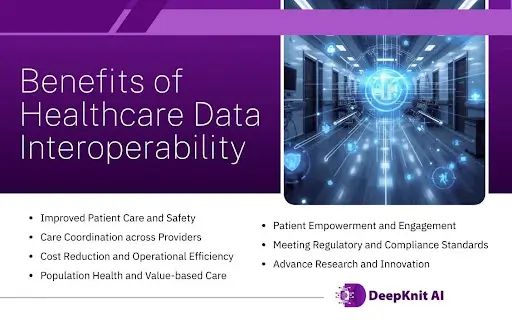
Let’s look into the benefits of healthcare data interoperability in detail:
- Improved Patient Care and Safety
- Care Coordination across Providers
- Cost Reduction and Operational Efficiency
- Population Health and Value-based Care
- Patient Empowerment and Engagement
- Meeting Regulatory and Compliance Standards
- Advance Research and Innovation
Interoperability reduces medical errors, duplicate tests, and adverse drug interactions by helping clinicians look into the complete patient histories—medications, allergies, lab results, and prior diagnoses. This helps them take more accurate and timely decisions.
In the event of discharge or referrals, interoperable systems facilitate smooth care transitions and prevent information gaps by allowing coordination among multiple stakeholders such as primary care physicians, specialists, hospitals, labs, pharmacies, and post-acute care providers.
Interoperability also enables reduced unnecessary spending and improves resource utilization as seamless clinical data exchange helps to avoid redundant tests, delayed diagnoses, and administrative inefficiencies.
Aggregated, high-quality data from multiple sources is the backbone of population health management. Interoperability enables risk stratification, chronic disease management, and outcome-based reimbursement models.
Interoperable systems allow patients to access their own health data, enabling informed decision-making, second opinions, and personalized care.
Standards like HIPAA, GDPR, and new national frameworks require secure, structured, accurate data sharing. Organizations without interoperability often struggle to meet these requirements, which results in the risk of fines, audit failures, or damaged reputation.
Large-scale research projects can benefit from pools of de-identified data that share common characteristics and a common vocabulary, and are continually updated.
Levels of Interoperability in Healthcare
Interoperability is not a single capability—it exists across multiple levels:
- Foundational Interoperability (Technical)
- Structural Interoperability (Syntactic)
- Semantic Interoperability
- Organizational Interoperability
The most basic level of interoperability is called foundational, which enables systems to send and receive bits and bytes of information from A to B. It ensures connectivity and security but does not ensure that the receiving system can interpret the data.
Example: Sending a scanned JPG of a lab report via secure messaging.
This level defines the format and syntax of the shared data. It ensures the receiving system can differentiate between the patient’s name and other information, such as blood pressure, other blood values, etc., and populate the appropriate fields on a health record. This helps in maintaining consistency in how information is exchanged.
ExampleA patient’s medication list is sent in a structured XML format. The receiving EHR automatically places “Omeprazole” in the medication tab rather than just showing it as a block of text.
Considered the “gold standard” for clinical data, semantic interoperability ensures that a diagnosis code or lab result has the same clinical meaning across systems. It eliminates ambiguity so that “heart attack” in System A is recognized exactly as “myocardial infarction” in System B.
ExampleLogical Observation Identifiers Names and Codes (LOINC) standardizes codes for lab tests, measurements, and clinical observations. Using a shared vocabulary ensures that test results can be understood and compared, even when they come from different labs or systems.
This is the highest level of interoperability that focuses on the human and legal side. This involves governance, policies, workflows, and legal agreements that enable data sharing across institutions and jurisdictions.
Example Data-sharing agreements between hospitals, payers, and research organizations.
Standards and Frameworks Enabling Interoperability in Healthcare Data Exchange
Interoperability in healthcare is built on agreed-upon rules, data models, and secure exchange methods that make it possible for different health systems to understand one another.
The following are the healthcare data standards and frameworks that are the basis of connected care:
- Health Level Seven (HL7) and HL7 v2: HL7 defines how patient health information is structured and exchanged. Its messaging formats, such as HL7 v2, are still widely used for tasks like lab orders, results, and admissions data. HL7 EMR integration provides the foundation for many data systems today.
- Fast Healthcare Interoperability Resources (FHIR): Developed by HL7, FHIR is a modern, lightweight, and flexible API-driven standard to make clinical data exchange faster, more flexible, and web-friendly. It uses a modular “resources” approach, which makes it easier for developers to build apps and APIs that integrate easily with existing systems.
- Digital Imaging and Communications in Medicine (DICOM): DICOM is the standard for storing and sharing medical images like MRIs, CTs, and X-rays. It ensures that both the image and its descriptive information remain intact and readable across different imaging equipment and viewing platforms.
- International Organization for Standardization (ISO): ISO sets global best practices for comprehensive data management, security, and quality in health information systems. Its health informatics standards cover everything from terminology to privacy protocols. This provides a common reference point worldwide.
- Logical Observation Identifiers Names and Codes (LOINC): LOINC standardizes codes for lab tests, measurements, and clinical observations. Using a shared vocabulary ensures that test results can be understood and compared, even when they come from different labs or systems.
- Systematized Nomenclature of Medicine – Clinical Terms (SNOMED CT): SNOMED CT is a comprehensive, standardized vocabulary for clinical terms. It allows different healthcare systems to describe diagnoses, symptoms, and procedures consistently. This makes data more searchable and usable.
- Integrating the Healthcare Enterprise (IHE) profiles: IHE develops profiles that describe how existing healthcare data standards should work together for specific workflows. This helps vendors and healthcare providers implement data interoperability in a way that solves real-world problems, not just technical ones.
- Application Programming Interfaces (APIs): APIs are the bridges that connect software systems and allow them to share data securely in real time. In healthcare, APIs, especially those based on FHIR, enable everything from patient portals to third-party app integrations.
- Government and Industry Regulations (HIPAA, GDPR, and others): Regulations define the legal and ethical framework for how data can be shared. The Health Insurance Portability and Accountability Act (HIPAA) governs privacy and security in the US, the General Data Protection Regulation (GDPR) does the same in the EU, and other regions have their own rules. Semantic interoperability must work within these boundaries.
- ONC Interoperability Standards Advisory (ISA): The US Office of the National Coordinator for Health IT maintains the ISA as a reference for the best available interoperability standards. It guides healthcare organizations in choosing the most widely accepted methods for clinical data exchange.
- Cross-Enterprise Document Sharing (XDS/XDS-I): XDS enables the sharing of medical documents between healthcare enterprises. XDS-I extends this to imaging, supporting the secure exchange of large image files alongside clinical documentation.
- International Classification of Diseases (ICD): ICD codes are used globally to classify diseases and health conditions. Standardizing diagnostic information helps in data aggregation, analysis, and sharing across borders.
Challenges of Healthcare Data Interoperability
Despite the many advancements made, interoperability remains difficult to achieve due to the following factors:
- Fragmented Healthcare IT Ecosystems: Healthcare organizations often use multiple legacy systems that were not designed to communicate with each other.
- Healthcare Data Silos and Vendor Lock-In: Proprietary data formats and closed systems limit seamless data exchange and create dependency on specific vendors.
Inconsistent Data Quality and Standards Adoption: Incomplete, inaccurate, or poorly structured data reduces trust and usability across systems. - Privacy, Security, and Compliance Concerns: Strict regulations such as HIPAA and GDPR, while necessary, add complexity to data sharing across organizations and borders.
- Lack of Governance and Incentives: Interoperability requires collaboration across competitors, which can be difficult without clear incentives and governance frameworks.
Role of Blockchain and AI in Enhancing Interoperability
Organizations are increasingly using blockchain and AI solutions to mitigate the challenges of interoperability in healthcare data sharing.
AI in healthcare data interoperability
AI is used for:
- Improving Data Quality: AI improves data quality with its ability to detect anomalies, duplicates, and missing data, improving trust in exchanged information.
- Intelligent Data Mapping and Normalization: AI models can reduce manual effort spent on mapping data from disparate formats into standardized structures by automating the process.
- Clinical Decision Support (CDS): Clinicians receive more accurate, real-time insights at the point of care by feeding AI analytics with interoperable data.
- Semantic Understanding of Unstructured Data: Natural Language Processing (NLP) helps extract meaningful insights from clinical notes, discharge summaries, and scanned documents.
- Predictive Analytics: Analyzes integrated data to predict risks, flag potential health issues early, and guide personalized treatment plans.
Blockchain for healthcare data exchange
Blockchain technology offers a complementary approach to interoperability, especially around trust, security, and data integrity.
Key Benefits:
- Immutable audit trails for data access.
- Decentralized identity and consent management.
- Tamper-proof data exchange logs.
- Enhanced patient control over data sharing.
Rather than storing clinical data on-chain, blockchain can serve as a secure coordination layer that manages access and verifies data provenance.
The Future of Healthcare Data Exchange
The future of interoperability lies in:
- API-first healthcare architectures
- AI-driven data harmonization
- Blockchain-enabled trust frameworks
- Cloud-native health information exchanges
- Patient-owned and consent-driven data models
Interoperability will no longer be a backend IT concern—it will be a strategic enabler of digital transformation, precision medicine, and value-based care.
Enabling True Interoperability to Break Healthcare Data Silos
With all the modern technologies like AI and blockchain in place, interoperability in healthcare data exchange is no longer a luxury but a necessity for delivering coordinated, high-quality, and patient-centric care. As healthcare ecosystems grow more complex, organizations need more than standards compliance; they need intelligent, scalable solutions that can unify fragmented data, ensure semantic consistency, and maintain trust across systems.
DeepKnit AI helps organizations move from disconnected healthcare data silos to truly interoperable ecosystems. By combining AI-driven data standardization, intelligent document processing, semantic mapping, and secure data exchange frameworks, DeepKnit AI enables seamless interoperability across EHRs, legacy systems, labs, payers, and emerging digital health platforms. Our solutions ensure that healthcare data is not just exchanged but is accurate, contextual, and clinically usable.
Trusted Data Interoperability for Modern Healthcare.
Connect with us for Blockchain and AI-driven health solutions.