

Robotic process automation (RPA) has redefined how enterprises conduct routine tasks. By automating resource-intensive, high volume repetitive workflows, RPA has helped businesses by enhancing efficiency and productivity. Yet its potential is limited when it comes to dynamic, context-aware automation with intelligent decision-making capabilities.
This is where decision engines (DEs) play a pivotal role — empowering RPA bots with intelligence, logic, and adaptability. Decision engines are AI-enabled software or systems built to automate and manage complex decision-making processes based on business rules, data inputs, and predictive analytics.
By combining decision engines with RPA, we can transform static workflow automation to intelligent automation – ones that not just automate but also think and take decisions.
Enhancing Automation Efficiency
While RPA mimics human interaction with digital systems like typing, copying, pasting etc. but with greater efficiency, it lacks flexibility and there is added complexity involved in adjusting and deploying rules once they have been established. These barriers can be bypassed with the help of decision engines, which would make it easier and faster to create, adjust, and deploy the rules that guide your RPA solution and keep your business running and reach high efficiency.
Here‘s how:
- Simplify Complex Rules: Decision engines allow you to build, modify, and configure rules with ease. This facilitates the handling of complex rule sets with ease.
- Update Rules without Modifying Process Logic: DEs enable the updating of specific rules without the need to alter the entire process logic. This targeted approach allows you to implement changes quickly and efficiently.
- Adjust and Deploy a Single Rule: Instead of redeploying an entire sequence, you can adjust and deploy a single rule. This focused approach enhances business agility and reduces the risk associated with extensive changes.
Benefits of Integrating Decision Engines with RPA
By combining decision engines with RPA, businesses can transform from “doing automation” to “thinking automation.”
- Smarter Automation: Decision engines will provide the necessary intelligence, and RPA can handle the execution. In loan processing, bots gather applicant data while the decision engine evaluates credit risk and makes an approval decision in seconds.
- Seamless Integration: You can integrate any existing automation system with DEs using APIs, ensuring a smooth and efficient transition.
- Real-time Decision-making: When it comes to time-critical operations like fraud detection or claims processing, decision engines can instantly analyze data, letting RPA bots act on insights without human intervention.
- Scalability and Agility: Reprogramming RPA according to evolving business rules is a hassle. This can be avoided as updates are made in the decision engines, which simplifies change management and ensures automation stays agile.
- Low-code Automation: You can streamline your process without the intervention of specialized developers and also minimize the risk of errors.
- Consistency and Compliance: The RPA-DE combination is ideal for maintaining compliance with policies and regulations as centralized rule management ensures every bot adheres to the same logic, reducing possible human errors.
- End-to-End Intelligence: Together, they close the loop — Data → Decision → Action → Feedback → Continuous Improvement.
How Decision Engines and RPA Work Together
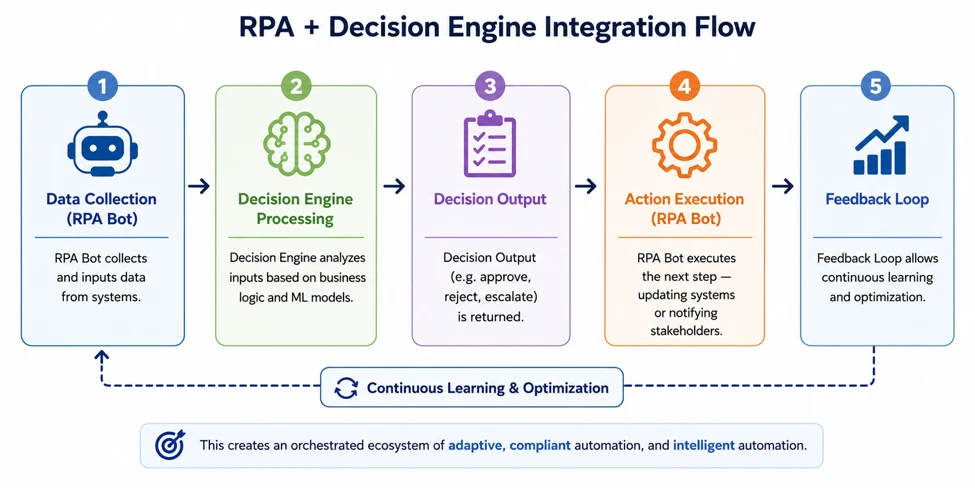
In an integrated automation workflow, RPA and the decision engine perform distinct but complementary functions.
The RPA bot handles repetitive interactions with applications, while the decision engine evaluates incoming information using business rules, predictive models, or AI algorithms. Once a decision is made, the bot immediately carries out the required action. Separating execution from decision-making makes workflows easier to update as business policies evolve.
Use Cases across Industries
| Industry | Application | Impact |
|---|---|---|
| Healthcare | Billing decisions, patient eligibility checks | Reduced manual review, faster reimbursements |
| Manufacturing | Quality control, predictive maintenance | Smarter workflows, minimized downtime |
| Banking and Finance | Credit scoring, fraud checks, compliance reviews | Faster approvals, reduced risk |
| Insurance | Underwriting, claims validation | Higher accuracy, better fraud control |
| Retail | Inventory management, dynamic pricing | Optimized stock levels, personalized offers |
Real Integration Examples
1. Banking: Intelligent Loan Processing
Instead of hardcoding approval rules into the automation workflow, RPA and decision engines work together to streamline loan processing.
RPA bot extracts applicant information from banking systems.
Decision engine evaluates:
- Credit score
- Debt-to-income ratio
- Repayment history
- Fraud indicators
- Lending policies
Decision output: Approve, reject, or request additional documentation.
RPA bot updates the loan management system and automatically notifies the applicant.
2. Healthcare: Prior Authorization Automation
Healthcare organizations process thousands of prior authorization requests every day. Integrating decision engines with RPA helps accelerate approvals while reducing administrative effort.
RPA bot gathers:
- Patient demographics
- Insurance information
- Physician documentation
- Data from Electronic Health Record (EHR) systems
Decision engine validates:
- Coverage rules
- Payer policies
- Medical necessity criteria
- Patient eligibility
Decision output: Automatically approve eligible requests or route exceptions for manual review.
Business impact: Reduced administrative workload and faster patient care.
3. Insurance: Intelligent Claims Processing
Insurance companies can automate claims processing while improving fraud detection and accuracy.
RPA bot collects:
- Claim documents
- Policy information
- Customer records
Decision engine analyzes:
- Coverage limits
- Policy compliance
- Potential fraud indicators
- Claim inconsistencies
Decision output: Approve, reject, or escalate the claim.
RPA bot updates the claims platform, sends customer notifications, and routes complex cases to human adjusters.
4. Manufacturing: Predictive Maintenance
Manufacturers can prevent equipment failures by combining real-time monitoring with intelligent decision-making.
RPA bot retrieves:
- Machine logs
- Sensor data
- Operating metrics
Decision engine evaluates:
- Vibration patterns
- Temperature readings
- Maintenance history
- Production schedules
Decision output: Determine whether maintenance is required.
RPA bot automatically creates work orders, updates maintenance schedules, and alerts engineering teams.
5. Retail: Dynamic Pricing and Inventory Management
Retailers can respond quickly to changing market conditions through intelligent automation.
RPA bot collects:
- Sales data
- Competitor pricing
- Inventory levels
- Supplier information
Decision engine evaluates:
- Demand forecasts
- Stock availability
- Seasonal trends
- Pricing strategies
Decision output: Recommend price adjustments or inventory replenishment.
RPA bot updates ERP systems, eCommerce platforms, and warehouse inventories automatically.
As AI technologies continue to mature, integrating decision engines with RPA is paving the way for workflows that can anticipate events, optimize processes in real time, and continuously improve with data-driven insights. This evolution is shaping the next generation of predictive and intelligent workflow management.
Conclusion
Combining decision engines with RPA transforms automation from static scripts into dynamic, data-driven decisioning systems that think, learn, and evolve. This fusion enables businesses to achieve faster decisions, greater accuracy, and continuous adaptability, unlocking the true potential of intelligent process automation.
Discover how DeepKnit AI can streamline your automation efforts and enhance your business agility. Connect with our experts to know more.
Transform your workflow automation from static to smart.