

Decision engines are essentially systems or software platforms used to automate business rules or decisions. These help in streamlining and enhancing the decision making process, saving you from manual work.
Besides business rules or decision workflow, data becomes the major fodder for business logic automation. Major decisions are the accumulation of a series of smaller decisions, and it is the function of the decision engine to determine how these smaller decisions lead to a final result. A decision engine basically automates these business decisions by accessing and integrating data from multiple sources and applying these ‘rules’ according to your criteria.
In this post, we shall look at the process of decision engine integration with your business workflow automation.
Real-world Examples of Automated Decision-making
Data-driven decision systems can help with various types of decisions for an organization. In general, they can be classified as:
- Strategic Decisions: These are usually complex long-term decisions like changing cost structures or planning for longer-term organizational growth. It would affect a much larger portion of the organization.
- Tactical Decisions: These are less complex but more focused ones usually aimed for shorter terms like the launching of a new product, changing product pricing or launching a specific marketing campaign for the next quarter to increase sales.
- Operational Decisions: Much smaller in scale and simpler, operational decisions usually deal with the day-to-day operations of the organization like managing inventory or setting daily production targets. They are usually executed in alignment with the overall strategic vision of an organization.
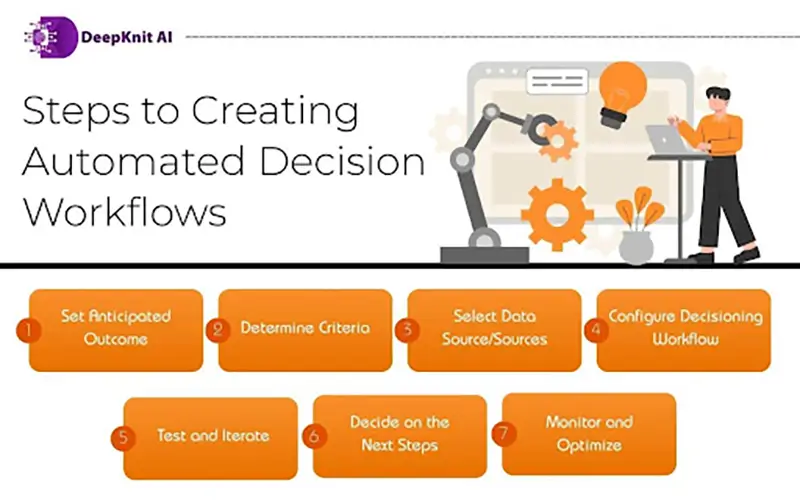
Steps to Build Automated Decision Workflows
Though it is up to the owner (business) of the decision engine to determine what is expected out of the business logic automation, there are some basic steps followed by all:
- Set Anticipated Outcome: This is the first and primary stage where you set your goals, and the specific business rules that you need your decision engine or workflows to work on.
- Determine Criteria: Set intelligent decision frameworks, or parameters for the decision engine to work on. In the case of credit applications, particular criteria often include job status, age, income, marital status, credit history, debt ratio, etc.
- Select Data Source/Sources: As was discussed before, decision engines rely on data, and it is important to choose relevant data sources. In the case of a loan application, the decision engine owner has to decide from where data is going to be sourced such as credit bureau data, social media, third-party sources etc.
- Configure Decisioning Workflow: You can configure your business rules or workflows as per your criteria to enable automated decisions.
- Test and Iterate: Once you see that the process is flowing, test it with samples. For example, if a person applies for an automotive loan, input his/her information into the decision engine and see what it does – is it pulling out all the necessary information like KYC, identity verification, income verification, credit score etc. and whether it is rightfully accepting or rejecting the application based on the criteria set by you? Check if there is anything missing, and see if the process can be made smoother. Repeat the process multiple times with different samples until you’re satisfied it is giving you the desired result.
- Decide on the Next Steps: Where is your threshold for complex applications? Which applications need manual intervention? Straight-through processing enables instant decisions for simpler credit and lending requests, while a rules-driven decisioning process helps to identify and re-route exceptions that require more manual intervention.
- Monitor and Optimize: As with any other AI automation systems, continuous monitoring is recommended for decision engines too. Evaluate whether it is giving you real business value. Keep a record of your decisioning performance, watch out for opportunities to improve the process and tools, and enable more efficient decisioning and business growth.
Conclusion
To sum up, decision engines are powerful systems that support automated decision-making across a range of industries, including finance, manufacturing, healthcare, legal and banking. They allow businesses to quickly make consistent, well-informed decisions by utilizing data and logical reasoning.
Are you looking for a robust decision engine to further develop your business? Experts at DeepKnit AI can help you get going without sweating because we have extensive experience in catering to the AI needs of clients across the globe.
Feel free to contact us.
Make Smarter Decisions with AI-powered Decision Engines.
Connect with a DeepKnit AI expert to find out more.
Click here for a consultation.