
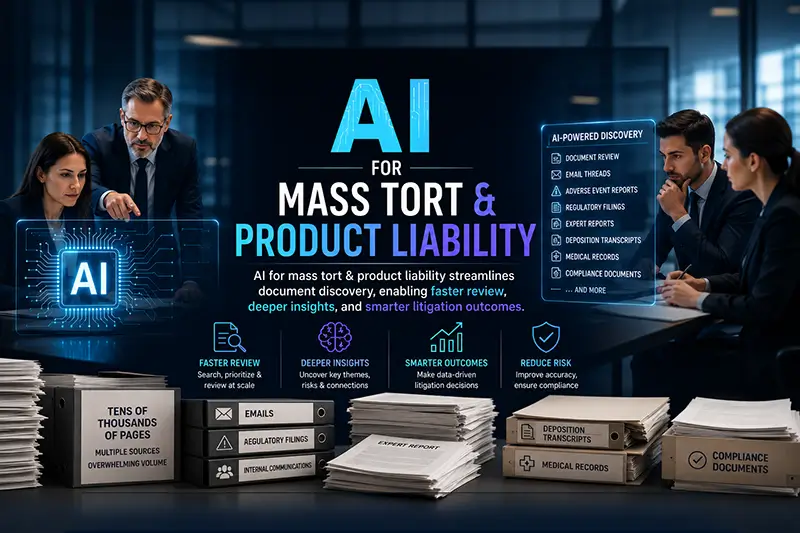
Imagine a legal team receiving tens of thousands of pages of documents related to a defective medical device, pharmaceutical product, or consumer product lawsuit!
Emails, regulatory filings, adverse event reports, internal communications, expert reports, deposition transcripts, medical records, compliance documents—all begin pouring in from multiple sources.
This is the reality of modern mass tort and product liability litigation. Teams are no longer dealing with complex law, but overwhelming volumes of electronically stored information (ESI) that must be reviewed, analyzed, and acted upon—in the blink of an eye.
AI for mass tort & product liability is rapidly changing that equation in favor of legal teams.
AI document discovery solutions are helping legal professionals manage massive datasets, identify relevant evidence faster, uncover hidden patterns, and make more informed litigation decisions. For law firms and legal service providers handling complex mass tort and product liability matters, AI has become a strategic advantage rather than simply a productivity tool.
Understanding the Discovery Problem in Mass Tort Litigation
Mass tort and product liability cases are typically document-intensive. Unlike standard litigation, these matters often involve:
- Tens of thousands of plaintiffs
- Multiple defendants
- Decades of historical records
- Extensive medical documentation
- Regulatory and compliance materials
- Scientific studies and detailed reports
The discovery process usually involves terabytes of information spread across multiple repositories and formats.
The litigation team must identify:
- Relevant evidence
- Privileged communications
- Risk elements
- Regulatory compliance issues
- Causation-related documentation
- Patterns of corporate knowledge/misconduct
The challenge here is not just to find documents but find them within the tight deadlines—quickly and accurately. When the stakes are high, manual review becomes unsustainable.
Why Traditional Document Discovery Falls Short
Traditional review methods of manual screening, linear reading, and fragmented workflows, simply cannot keep pace. In fact, document review has historically been one of the most labor-intensive and expensive phases of litigation, often requiring teams to sift through vast datasets manually.
The result?
- Escalating costs
- Delayed timelines
- Increased risk of missing critical evidence
How AI Transforms High-volume Document Discovery
AI introduces automation, intelligence, and contextual understanding into the discovery process.
Rather than simply searching for keywords, modern AI systems analyze relationships, context, meaning, and patterns across large collections of documents.
This enables legal teams to move beyond document review and toward evidence intelligence.
- Automated Document Classification & Prioritization
- Critical documents are surfaced early
- Redundant or irrelevant data is deprioritized
- Review cycles are streamlined
AI systems can rapidly scan and categorize thousands (or millions) of documents based on relevance, privilege, or case-specific criteria.
This ensures:
Predictive coding further refines this process by continuously learning from reviewer input, improving accuracy over time.
- Medical Record Summarization & Chronology Creation
- Extract key events from thousands of pages
- Build structured timelines
- Highlight inconsistencies or gaps
In product liability cases, especially those involving pharmaceuticals or medical devices, medical records are pivotal to causation arguments.
AI can:
Historically, summarizing medical records required extensive manual effort. AI is now enabling these tasks to be completed in minutes rather than days.
- Pattern Detection across Plaintiffs
- Common injuries
- Similar product failures
- Repeated corporate behaviors
- Detect correlations across thousands of claims
- Identify emerging litigation themes
- Strengthen causation and liability arguments
Mass tort litigation often hinges on identifying patterns:
AI can analyze large datasets to:
Advanced analytics tools can uncover relationships between documents that human reviewers may miss.
- Early Case Assessment (ECA)
- Rapid intake and eligibility analysis
- Automated data extraction from initial documents
- Faster go/no-go decisions
Before investing time and resources into litigation, firms need to determine case viability.
AI enables:
This enables firms to focus on high-merit cases while minimizing exposure to weak claims.
- Compliance, Privilege, and Risk Flagging
- Identify PII/PHI automatically
- Flag privileged communications
- Ensure regulatory adherence
Handling sensitive data—especially protected health information (PHI)—requires strict compliance.
AI solutions can:
This is very much significant in product liability cases involving patient data, manufacturers, and healthcare providers.
AI’s Role in Product Liability Investigations
Product liability litigation requires reconstructing what a company knew, when it knew it, and how it responded.
This process involves analyzing large quantities of communications and records across multiple departments.
AI can help uncover:
- Product development timelines
- Internal safety discussions
- Regulatory correspondence
- Risk assessments
- Quality assurance findings
- Complaint histories
By connecting information across previously disconnected documents, AI helps legal teams build a clearer picture of potential liability.
The ability to surface hidden relationships between documents can be especially valuable when investigating long-term product issues that span years or decades.
Managing Medical Records at Scale
Medical evidence plays a central role in many mass tort cases, particularly those involving pharmaceuticals, medical devices, environmental exposures, and toxic torts.
Plaintiff medical records often contain:
- Physician notes
- Diagnostic reports
- Laboratory results
- Treatment histories
- Hospital records
- Medication histories
Reviewing these records manually is both time-consuming and resource-intensive.
AI-powered medical document processing can:
- Extract key clinical information
- Identify diagnoses and treatments
- Highlight important timelines
- Summarize lengthy records
- Organize medical evidence chronologically
This enables legal teams to assess causation and damages more efficiently while maintaining focus on case strategy.
Enhancing Accuracy and Defensibility
One common concern surrounding AI in legal discovery is accuracy.
Modern AI systems are increasingly designed with transparency and human oversight in mind.
Rather than replacing legal professionals, AI serves as an intelligent assistant that helps reviewers work more effectively.
Human reviewers remain responsible for:
- Final relevance determinations
- Privilege assessments
- Legal strategy decisions
- Quality assurance
This human-in-the-loop approach combines the speed of automation with the judgment and expertise of experienced legal professionals.
The result is a more defensible and consistent discovery process.
How DeepKnit AI Helps Transform High-volume Legal Discovery
Mass tort and product liability litigation demands more than just document storage and keyword searches. It’s more about transforming volumes of unstructured information into actionable intelligence.
This is where platforms like DeepKnit AI are redefining legal AI adoption.
DeepKnit AI goes beyond standard automation by combining:
- Advanced OCR + Intelligent Character Recognition (ICR) for handwritten and noisy data
- Context-aware AI models that understand document nuances
- Automated classification, extraction, and summarization
- Customizable output templates aligned with legal workflows
Its AI models can:
- Process unstructured and structured documents at scale
- Identify, segregate, and organize co-mingled data
- Generate clean, structured insights ready for legal analysis
This enables legal teams to move from:
Raw, segregated documents → Actionable intelligence
DeepKnit AI is designed to integrate seamlessly into existing workflows, ensuring efficiency, accuracy, and scalability across high-volume discovery environments.
The Future of Mass Tort Discovery
With litigation datasets continuing to expand, AI adoption within legal discovery will likely accelerate.
Future AI-driven discovery platforms will increasingly offer:
- Real-time evidence analysis
- Predictive case insights
- Automated chronology generation
- Cross-document relationship mapping
- Advanced litigation intelligence
- Multi-source data integration
Organizations that embrace these technologies early will be better poised to manage complex litigation efficiently while controlling costs and improving outcomes.
The goal is no longer about reviewing documents faster. It’s about uncovering critical insights that can shape litigation strategy from the earliest stages of a case.
Don’t Let Critical Evidence Remain Buried in Unstructured Data.
Collaborate with DeepKnit AI to automate document-intensive workflows and gain deeper insights across every stage of litigation.
Contact Us