
While proactive and preventative healthcare is gaining importance, healthcare at scale is something that would go a long way in not only enhancing efficiency but also cutting costs of all parties included—patients, healthcare organizations and insurers.
AI in population health management (PHM) does just that. How can AI play a significant role in this regard?
Early disease detection models using AI tools like predictive analytics and machine learning for disease detection are the foundation of effective PHM. As the newer approach is more based on analyzing vast volumes of historical and current patient datasets, AI can outperform humans in its execution.
Early diagnosis using AI empowers healthcare providers to identify risks long before symptoms become apparent, improve clinical decision support (CDS), reduce healthcare costs, and ultimately enhance patient outcomes. Whether it’s early detection of diseases like cancer or critical heart conditions, predicting the onset of chronic diseases like COPD, or identifying epidemic disease outbreaks, AI is redefining how we think about wellness, prevention, and long-term care.
This blog explores how AI is transforming early disease detection, its application in PHM, its core technologies, benefits, and challenges for AI-driven PHM.
Understanding AI in Population Health Management (PHM)
Population health management (PHM) is a strategic, data-driven, and preventative approach to healthcare aimed at improving care for not just individual patients but a defined group of individuals (a population). In this context, a “population” could be all residents of a certain geography, all members of a specific health plan, or even a subset like people with diabetes or all individuals over 65.
Instead of the traditional reactive treatment of individuals after illnesses occur, PHM aims to keep people healthy and well through proactive interventions or by managing chronic conditions effectively to prevent complications. And this is done through early diagnosis using AI by analyzing large amounts of patient data collected from:
- Healthcare Providers: Doctors, nurses, specialists, and hospitals (EHRs).
- Public Health Agencies: Local and state health departments.
- Community Organizations: Social services, housing agencies, schools, and non-profits.
- Insurers/Payers: Organizations that finance the care.
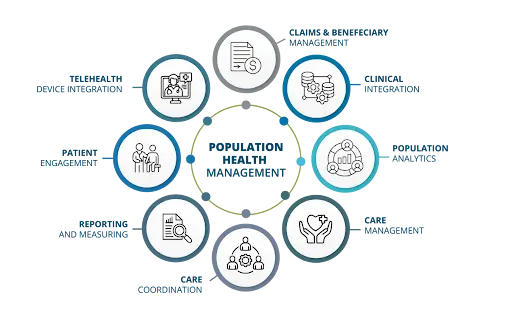
Data of patients, like previous health records, ongoing treatments, living conditions, diet, exercise regimen, habits (smoking, drinking), income, and much more, are collected and selected to create ‘populations’ or subsets intended for care.
This makes PHM essentially a collaborative process that extends beyond the walls of the hospital or clinic, and this is where AI plays a significant role, as it can process these large datasets more efficiently.
Why Early Disease Detection Matters in Population Health
Throughout history, we have witnessed how epidemic or pandemic breakouts can disrupt social and economic systems when we least expect it. Events like the 1918 Spanish Flu, the 2003 Severe Acute Respiratory Syndrome (SARS) outbreak, the 2014 Ebola virus outbreaks, and the recent COVID-19 pandemic serve as examples of the serious threat posed by infectious diseases. These remind us of the importance of learning from the past and continuously improving our ability to detect and respond to outbreaks more effectively, informed by reviews of early warning systems (EWS).
Besides being prepared for such global events, EWS and early disease detection are also useful in:
- Preventing Disease Progression
- Early diagnosis of cancer using AI leads to better survival rates.
- Detecting diabetes at an early stage can lead to controlling it with lifestyle changes rather than costly and cumbersome medications.
- Chronic respiratory illnesses can be managed better when detected before lung capacity declines significantly.
Identifying or diagnosing the onset of diseases at an early stage makes treatment easier, more effective, and less costly. For example:
- Reducing Healthcare Costs
Treating patients after the occurrence of a disease involves complex interventions, hospitalizations, and long-term care, which contribute to costs on the side of all parties involved—patients, insurers, and caregivers. AI-enabled screening helps reduce avoidable expenses by identifying high-risk individuals early.
- Enhancing the Quality of Life
Patients can enjoy overall well-being from timely intervention, leading to fewer complications, faster recovery, and decreased medications.
- Supporting Preventative and Personalized Care Plans
- Allocate resources efficiently
- Personalize risk-based interventions
- Enhance long-term health outcomes across communities
PHM’s goal is to enable proactive care. Early detection allows healthcare organizations to:
How AI Helps Detect Diseases Early in Population Health
Early diagnosis using AI helps rapidly analyze vast patient datasets, including electronic health records (EHRs), medical images, genomics, wearables, lifestyle data, and more, and derive insights that enable early intervention.
The following are the core technologies used in AI in population health management:
- Machine Learning Algorithms
Machine learning for disease detection enables models to identify hidden correlations between patient data, risk factors, and early disease signals. Common ML algorithms used in early detection include:
- Random Forests – classify disease risks using multiple decision trees
- Gradient Boosting Machines – detect non-linear patterns
- Support Vector Machines (SVMs) – classify patient risk categories
- Logistic Regression (LR) – predict probability of disease occurrence
ML models are particularly effective for chronic disease risks such as diabetes, hypertension, and kidney disease. For example, a study to assess the effectiveness of employing ML algorithms for the early identification of type 2 diabetes mellitus (T2DM) showed that “the Random Forest algorithm achieves an impressive accuracy of 98% in detecting T2DM.”
- Deep Learning for Medical Imaging
Deep learning (DL) has revolutionized radiology and pathology. CNNs (Convolutional Neural Networks) can analyze complex imaging data and detect minute anomalies. AI can detect early signs of:
- Lung nodules in chest CT scans
- Retinal damage from diabetes
- Breast cancer tumors in mammograms
- Early-stage brain tumors in MRIs
A study by Lancet Digital Health showed that “replacing one radiologist with AI for independent reading of screening mammograms resulted in a 4% higher non-inferior cancer detection rate compared with radiologist double reading.”
- Natural Language Processing (NLP)
NLP extracts valuable clinical information from unstructured data such as:
- Clinical notes
- Pathology reports
- Research articles
- Patient messages and chatbots
For example, NLP can flag high-risk symptoms documented in patient notes but not coded formally in EHRs.
- Predictive Analytics
Predictive models combine various data sources to forecast the probability of disease onset. In PHM, predictive analytics helps:
- Identify patients most at risk of hospitalization and readmissions
- Flag rising-risk individuals before they deteriorate
- Prioritize interventions for chronic disease management
These insights enable healthcare organizations to intervene early and manage resources efficiently. For example, a study by the Centers for Disease Control (CDC) states that predictive analytics has reduced hospital readmissions by up to 25%.
- AI-Powered Wearables and Remote Monitoring
Wearables equipped with sensors collect real-time physiological data such as:
- Heart rate
- Blood pressure
- Sleep quality
- Activity levels
- Blood oxygen levels
AI algorithms analyze these signals continuously to detect early abnormalities. Examples:
- Early detection of atrial fibrillation (AFib)
- Predicting heart failure exacerbation
- Identifying sleep apnea patterns
- This real-time monitoring allows proactive care outside hospital walls.
- Genomics and Precision Health
AI supports genomic sequencing and mutation analysis to predict genetic risks for:
- Breast cancer
- Cardiovascular diseases
- Neurodegenerative disorders
By combining genomics with health data, AI in preventive care is made possible.
Real-World Applications of AI in Early Disease Detection
AI in digital health technologies has been evolving for decades, and one of its first early adaptations can be seen in MYCIN, an AI program developed at Stanford University to diagnose bacterial infections (like blood infections) and recommend appropriate antibiotic treatments. While it didn’t focus on subtle, early disease signs in the modern sense (like analyzing an X-ray for a tiny lesion), it represented the first major attempt at using AI to process complex medical information to arrive at a diagnosis, which is a key component of disease detection. Another notable system from the same period was INTERNIST-I, developed in 1971 by the University of Pittsburgh as an educational experiment.
Well, the applications of AI in healthcare have evolved by leaps and bounds since then and are now actively transforming public health. According to Our World in Data, the top three causes of death in the world are cardiovascular disease, cancer, and respiratory disease. So let us see how AI is used in the detection, diagnosis, and treatment of these three major fatal diseases and some others too:
- Cancer Detection and Treatment
- AI models identify precancerous polyps in colonoscopies.
- Radiology AI tools detect lung cancer earlier than traditional scans.
- AI systems like Google’s LYNA detect breast cancer metastases with high accuracy.
Example: A study from the UK has shown that AI algorithms were able to find tumors in scans of patients with lung cancer with more accuracy than professional radiologists. The team reported that the system correctly detected early stages of lung cancer 94% of the time. Another study suggests that only 5% of patients with stage 4 lung cancer will survive for more than 5 years, compared to 55% of those diagnosed with stage 1 cancer.
- Predicting Chronic Disease Onset
AI is widely used to detect early risks for:
- Diabetes
- Hypertension
- Chronic kidney disease
- COPD (Chronic Obstructive Pulmonary Disorder)
For example, ML models trained on EHR data can identify individuals at risk of diabetes up to 5 years before diagnosis.
Example: A research study conducted to test the effectiveness of AI in early predictions of the severity of COPD using a sample of 8983 participants was able to predict patients with COPD who were most likely to have COPD exacerbation events and those with the highest mortality. AI also classified these participants into categories with high to low probability of developing emphysema.
- Cardiovascular Risk Prediction
AI-powered ECG analysis detects:
- Arrhythmias
- Risk of heart failure
- Risk of stroke
- Silent atrial fibrillation
- Sudden cardiac arrest indicators
Example: A 2017 study involving patients at risk of stroke used AI algorithms based on symptoms and genetic history to place them into an early detection stage. The study found that the early detection alert from the algorithm provided 87.6% accuracy in diagnosis and prognosis. It allowed for earlier implementation of treatment and prediction of whether a patient had a higher risk of future stroke.
Wearable devices have democratized cardiac monitoring for millions.
- Infectious Disease Surveillance
AI detects outbreaks and infection patterns by analyzing:
- Clinical symptoms
- Social media trends
- Environmental sensors
- Population mobility data
During COVID-19, AI platforms predicted outbreak hotspots ahead of time.
- Mental Health Early Detection
AI tools analyze speech patterns, behavioral data, and sentiment from digital interactions to detect:
- Anxiety patterns
- Cognitive impairment
- Early signs of depression
This helps clinicians provide timely psychological support.
- Maternal and Neonatal Risk Prediction
AI in preventive care for mothers and newborns identifies early risks such as:
- Preterm birth
- Preeclampsia
- Gestational diabetes
Challenges of Using AI for Clinical Early Detection
While promising, any AI solution is highly data driven and is only as good as the data it is trained on. The adoption of AI-driven early disease detection faces the following challenges:
- Data Privacy and Security: Healthcare data is highly sensitive; breaches can erode trust. Robust security frameworks are essential.
- Algorithm Bias: If training data lacks diversity, AI may produce biased predictions. Ensuring inclusive datasets is crucial.
- Lack of Standardized Data: EHR formats differ across systems, making data integration complex.
- Clinical Workflow Integration: AI models must align with clinicians’ workflows to prevent burnout or alert fatigue.
- Regulatory Compliance: AI-powered medical tools must meet stringent regulatory standards before clinical deployment.
Building a Healthier Future with AI-driven Population Health Management
Being able to predict pandemic outbreaks or manage community health is essential for a healthier, inclusive, secure future, and AI in population health management is the way forward. Healthcare systems that focus on population health management can more strategically deploy healthcare resources to improve health outcomes and the patient experience. Chronic diseases like hypertension, obesity, diabetes, and asthma account for a significant portion of the overall healthcare spending. Healthcare systems must identify these conditions early to better collaborate and meet patients’ needs.
While AI offers great promise for improving infectious disease surveillance and global health preparedness, achieving these benefits requires a coordinated effort. Continued focus on developing transparent, fair, and ethical AI technologies is needed, along with improvements in data management, training of health workers, and international cooperation. Experienced partners like DeepKnit AI, with extensive expertise in implementing digital health technologies, can be of assistance. We can help meet your healthcare AI requirements, from implementation through maintaining regulations and compliance.
Care for the Future with AI-driven Population Health Management.
Enhance Your Healthcare Portfolio with AI-driven Innovation.
Click here to reach an expert.