

What happens when artificial intelligence reviews 50,000 pages of legal and medical records in a fraction of the time it would take a human team?
The answer is impressive. However, it’s not the whole story.
While AI can significantly speed up document review, case analysis, medical chronology creation, and data extraction, legal professionals know that speed alone doesn’t win cases.
And that’s because nearly 1 in 4 of them have encountered AI-generated content to bring in factual errors. A single overlooked detail or misinterpreted record can have significant consequences in litigation, compliance, and case strategy.
However, that hasn’t slowed down the adoption of AI tools in law firms. In fact, it is accelerating faster than the guardrails around them.
That’s why forward-thinking law firms are increasingly adopting a Human-in-the-Loop (HITL) approach: an intelligent workflow where AI handles the time-consuming, redundant yet important tasks while legal experts provide oversight, validation, and decision-making.
In this post, we shall explore why HITL is the ultimate quality control every law firm needs to adopt for their workflows.
What Is Human-in-the-Loop (HITL)?
Human-in-the-Loop (HITL) refers to a workflow where human expertise is integrated directly into AI-driven processes, particularly at critical decision points.
Instead of fully automating tasks, HITL ensures:
- AI performs repetitive, data-heavy tasks
- Humans review, validate, and interpret outputs
- Final decisions remain under human control
This collaborative model allows firms to combine the speed of automation with the judgment, context, and accountability of legal professionals.
In high-risk industries like law, healthcare, and finance, HITL is no longer an optional asset but foundational towards responsible AI adoption.
Why Law Firms Need Human-in-the-Loop AI
Legal work operates in a zero-tolerance environment. A missed clause in an M&A agreement, an incorrect citation in a brief, or a misread regulatory update doesn’t just create rework; but liability.
AI language models, for all their capability, are probabilistic by nature. They predict the most likely output based on training data. That works remarkably well most of the time. However, “most of the time” is not a standard any attorney would accept for a client deliverable.
Consider where errors tend to surface:
- Document review: AI may flag or miss issues based on pattern recognition, not legal judgment.
- Contract drafting: Boilerplate can be subtly wrong when jurisdiction-specific nuance matters.
- Legal research: Older or niche case law may be misrepresented or hallucinated entirely.
- Compliance monitoring: Regulatory interpretation requires human context that models don’t always have.
These aren’t hypotheticals. They’re the exact failure points firms are encountering as AI adoption scales. HITL is the structured response and a core component of a modern legal AI workflow.
How HITL Actually Works in a Law Firm Setting
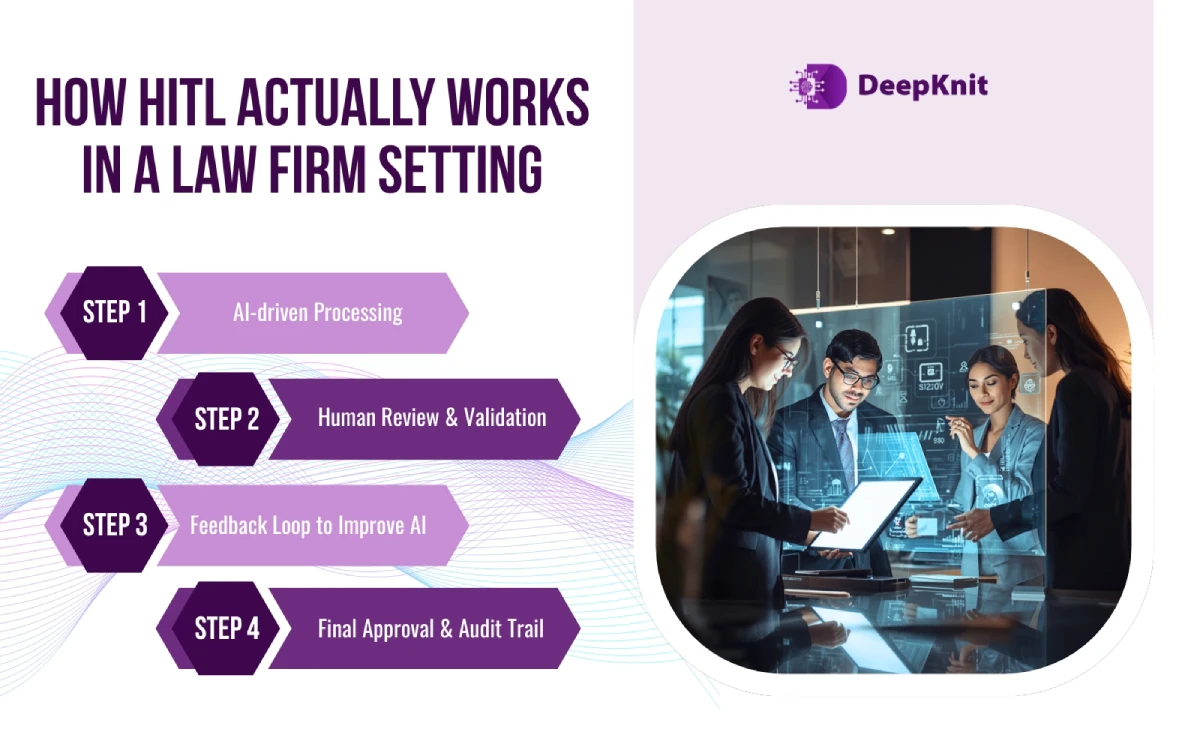
A well-designed HITL workflow isn’t about having someone re-read everything the AI produces, as that defeats the efficiency gain. It’s about intelligent checkpoints placed where human judgment adds irreplaceable value.
Here’s what that looks like in practice:
Step 1: AI-driven Processing
AI handles:
- Document classification
- Data extraction
- Contract summarization
- eDiscovery filtering
This reduces manual workload and accelerates throughput.
Step 2: Human Review & Validation
Legal professionals:
- Verify outputs for accuracy
- Correct errors or inconsistencies
- Apply contextual interpretation
This step ensures defensibility and precision.
Step 3: Feedback Loop to Improve AI
Corrections made by humans are fed back into the AI system:
- Improving accuracy over time
- Reducing repeat errors
- Adapting to firm-specific workflows
Step 4: Final Approval & Audit Trail
Every decision is:
- Confirmed by a human
- Logged with traceable actions
- Stored for compliance and audits
This creates a transparent, auditable workflow essential for legal operations.
Where HITL Fits in Legal Operations
HITL is not limited to one function, as it applies across multiple legal workflows:
- Contract Review: AI extracts clauses → Humans validate risk interpretation
- eDiscovery: AI filters large datasets → Humans assess relevance and privilege
- Legal Research: AI retrieves case law → Humans verify citations and context
- Document Processing: AI structures unstructured data → Humans ensure completeness and accuracy
In each case, HITL turns AI from a black-box tool into a controlled, reliable system.
Key Benefits of Human-in-the-Loop for Law Firms
The principal benefit of HITL among others is improved accuracy and efficiency. Other benefits include:
- Higher Accuracy without Sacrificing Speed: AI can analyze thousands of pages in minutes, while human reviewers verify critical findings.
The result is significantly faster turnaround times without compromising quality.
- Reduced Attorney Burnout: Legal professionals spend less time on repetitive review tasks and more time focusing on strategic legal work.
This improves productivity while allowing attorneys to concentrate on higher-value activities.
- Better Risk Management: HITL introduces multiple validation checkpoints that reduce the likelihood of errors reaching clients, courts, or regulatory bodies.
- Greater Client Confidence: Clients increasingly expect firms to leverage modern technology. However, they also expect reliability.
A human-in-the-loop workflow demonstrates that the firm is embracing innovation responsibly.
- Continuous Process Improvement: Every review cycle generates valuable feedback that can be used to refine AI performance and strengthen long-term legal workflow automation initiatives.
What to Look for in a HITL-ready AI Solution
Not every AI platform is built with HITL in mind. If you’re evaluating tools for your firm, these are the capabilities that matter:
- Explainability: Can the system show why it produced a given output?
- Configurable review thresholds: Can you set different oversight levels for different task types?
- Audit trails: Is every human review logged, timestamped, and retrievable?
- Feedback integration: Does reviewer input actually improve model performance?
- Role-based access: Can you assign review tasks to the right level of seniority?
If the answer to all of them is a resounding ‘yes’, then the platform is enterprise-ready for legal use.
Partner with DeepKnit AI to Build Smarter Legal Workflows
At DeepKnit AI, we believe the future of legal technology isn’t AI alone, but AI guided by human expertise.
Our intelligent workflow automation solutions are designed to help organizations streamline complex processes while maintaining the accuracy, transparency, and quality control that modern legal operations demand.
Whether you’re looking to accelerate medical record review, improve document intelligence, or build scalable AI-powered workflows, DeepKnit AI delivers solutions that keep humans where they matter most—in control.
The Future of Legal AI Is Human-guided
The legal profession has never been solely about processing information. It is about applying judgment, understanding context, and making informed decisions.
AI excels at identifying patterns and accelerating workflows.
Humans excel at reasoning, strategy, and accountability.
The most effective legal operations combine both strengths.
Human-in-the-loop is the perfect architecture that makes AI a genuine productivity multiplier rather than a liability waiting to happen.
The future of legal work isn’t AI or attorneys. It’s both, working in a workflow designed to bring out the best in each.
Build AI Workflows Your Legal Team Can Trust.
Partner with DeepKnit AI to implement human-in-the-loop systems that ensure accuracy, compliance, and scalability.
Contact Us