
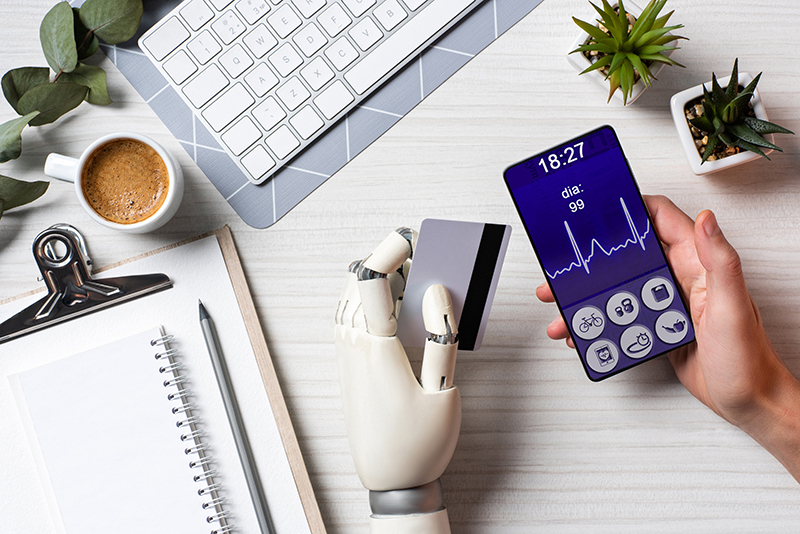
Artificial Intelligence (AI) has a big role to play in healthcare, and a recent development that is taking over the industry is the introduction of AI digital assistants, otherwise called virtual healthcare assistants. Driven by a rising demand for efficiency, the need to reduce clinician burnout, and enhanced patient care, investment in the new technology surged from US$390 million in 2023 to US$800 million in 2025.
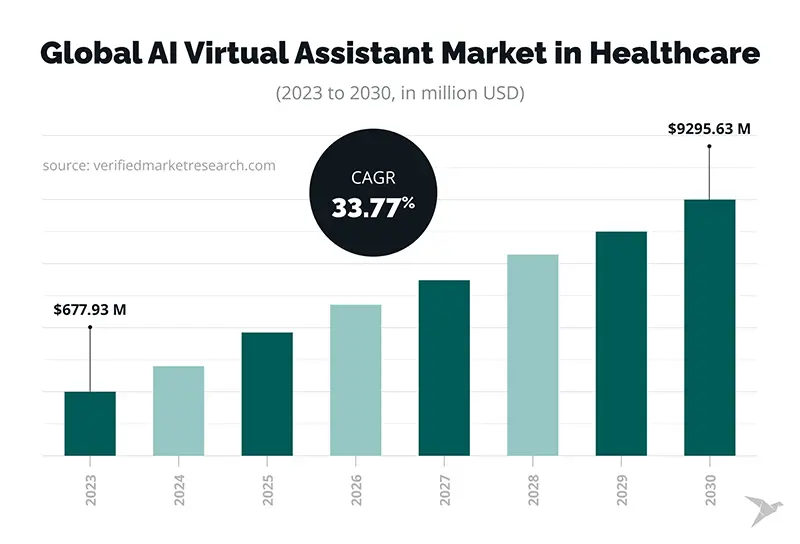
Image source:
With the capability to seamlessly integrate with electronic health records (EHR) systems, these digital assistants are redefining how clinicians interact with patient data. This new AI-powered technology use natural language processing (NLP), predictive analytics, and machine learning (ML) to automate administrative tasks, enhance decision-making, and improve patient engagement, besides being able to perform real-time transcription of doctor-patient interactions and has contextual understanding, which makes it a pivotal tool for healthcare professionals.
AI Digital Assistants: What Are They?
AI-powered digital assistants are built to operate as your virtual assistants, skilled at undertaking a wide range of tasks, including transcribing doctor-patient conversations, retrieving patient data from EHR systems, and more. Further, they can be fine-tuned and trained to work using a tailored knowledge base, depending on specific areas of focus.
It is a common mistake to confuse AI digital assistants with AI chatbots and AI agents, when in reality they are not the same — even though the terms are often used interchangeably. The main differentiator between them is their capabilities.
While AI chatbots are great tools for handling simple and repetitive tasks like answering simple queries and scheduling appointments, AI agents take up more complex tasks like automatically updating patient information or scheduling follow-up meetings.
AI digital assistants, on the other hand, are more sophisticated than chatbots but less independent than AI agents. While they can comprehend structured data, such as vital signs and lab results, they can also make sense of unstructured data, such as electronic health records, clinical notes, and clinical treatment protocols, and all of these make them capable to understand queries in context.
Benefits of AI Assistants in Healthcare
The table below will give a comprehensive list of the key capabilities and benefits of AI digital assistants in EHR:
| Capability | Description | Key Benefits |
|---|---|---|
| Workflow Automation | Automates routine administrative tasks like appointment scheduling, reminders, and record updates. | Increases efficiency, reduces administrative burden. |
| Data Summarization and Insights | Generates patient summaries, identifies trends, and visualizes critical health data. | Enables quick understanding of patient history and health status. |
| Information Retrieval and Clinical Querying | Enables natural language queries to quickly find data within the EHR (e.g. lab results, diagnoses, medications). | Speeds up data access, improves decision-making accuracy. |
| Clinical Decision Support | Provides real-time alerts, evidence-based recommendations, and predictive risk notifications. | Enhances care quality, reduces medical errors. |
| Automated Clinical Documentation | Captures and transcribes patient–physician conversations; summarizes key clinical details automatically. | Saves time, reduces manual entry, minimizes clinician burnout. |
| Voice and Conversational Interfaces | Allows clinicians to interact hands-free using voice commands or conversational prompts. | Improves usability and productivity during patient care. |
| Predictive Analytics and Risk Stratification | Analyzes data to identify high-risk patients and suggest preventive care actions. | Supports proactive, personalized treatment plans. |
| Privacy and Compliance Support | Ensures HIPAA/GDPR compliance, encrypts data, and manages access controls. | Strengthens data security and regulatory compliance. |
| Integration and Interoperability | Connects seamlessly with other healthcare systems using FHIR/HL7 APIs. | Facilitates coordinated, unified patient care across systems. |
| Patient Engagement | Sends reminders, education materials, and supports patient queries. | Improves patient adherence, satisfaction, and outcomes. |
Integration of AI Assistants with EHR
Integrating AI assistant tools with EHR systems involves embedding intelligent, voice or text-based AI tools within the EHR interface. These AI assistants can not only understand clinician commands, extract relevant patient data, transcribe patient-doctor conversations, but also schedule tasks, and even provide clinical insights — all without the need for any manual navigation through complex EHR menus.
Integration typically happens through:
- APIs and FHIR standards (Fast Healthcare Interoperability Resources): Enable smooth data exchange between EHRs and AI platforms.
- NLP (Natural Language Processing): Helps the assistant understand medical language, notes, and voice commands.
- Machine Learning Models: Analyze clinical data, identify trends, and make evidence-based recommendations.
- Voice and Chat Interfaces: Allow clinicians to interact conversationally — e.g. “Show me Mr. John Doe’s latest lab results.”
Right Results with Right Training
The applications and benefits of virtual healthcare assistants are many and show great promise of improvements in the future. Also, this AI in healthcare technology can be a reliable source of second opinion in medical care, while also automating administrative tasks, thereby enhancing the overall quality of healthcare.
However, as in the case of any AI application, diligent training is the key to their optimal performance, as they can be only as good as the input data and regular audits to eliminate any AI bias. With high-quality diverse datasets, continuous monitoring and data audits, and proper EHR integration, these AI assistant tools can become trusted tools in everyday life for both healthcare professionals and patients.
For optimum results, virtual healthcare assistants need to be integrated into healthcare organizations’ existing systems, such as electronic health records (EHRs) or scheduling systems. Once set up, they bring many advantages to the table, as was explained before.
Nevertheless to get this done, you’d need the help of an expert in the field, and this is where a seasoned partner like DeepKnit AI can assist you. With experience is deploying AI in healthcare, DeepKnit AI can help you build your AI digital assistant and integrate it with your legacy system without hassles, so that you can save yourself the many troubles of it, and concentrate on your core functions.
Let an AI Digital Assistant Enhance Your Productivity.
DK AI Can Efficiently Fulfil Your Digital Needs.
Call our Expert