

65% of insurance companies have now incorporated artificial intelligence in some form, from fraud detection to claims automation. However, barely half of them have fully understood how to leverage AI for litigation support.
It is a peculiar paradox: the industry that thrives on risk mitigation has only begun to grasp the full power of AI in tackling complex legal and claims-related challenges.
But the truth is clear—AI is no longer a future add-on for insurers and legal professionals. It’s the operational core of modern efficiency.
From processing thousands of claim documents to flagging discrepancies in fraudulent activities, to assisting legal teams in personal injury or workers’ compensation cases, AI in insurance and litigation support has redefined what “support” truly means in the insurance-litigation ecosystem.
In this post, we shall explore how this transformation is unfolding, and why forward-thinking firms are choosing intelligent platforms like DeepKnit AI to make sense of their growing data labyrinths.
Data Overload: A Shared Challenge for Insurance and Litigation
Insurance and litigation have always had a common foe—data overload.
When an accident, workplace injury, or malpractice claim occurs, a tidal wave of data follows:
- Medical records
- Policy documents
- Billing information
- Witness statements
- Legal correspondence
- Prior claim histories
Traditionally, these documents required human experts to comb through, interpret, and summarize. However, the process is both labor-intensive and error-prone, especially when accuracy directly impacts claim outcomes or court decisions.
Enter Artificial Intelligence (AI), the game-changer that filters clutter to impart clarity.
Learn how AI improves speed, accuracy, and case preparation in AI Medical Record Review: How Legal Teams Can Save Time and Improve Accuracy.
How AI Is Transforming Insurance Claims Processing
Let’s start at the beginning: the insurance lifecycle. Every phase of it, ranging from underwriting to claims processing, is now being quietly revolutionized by AI systems that learn, predict, and decide.
- Smarter Risk Assessment and Underwriting
AI models are helping insurers analyze patterns from thousands of past cases, combining data from medical histories, geolocation, occupation, and behavioral trends. This allows insurers to evaluate risk with greater precision, reduce biases, and even create personalized policy recommendations.
For instance, instead of relying solely on standard demographic data, AI can integrate predictive analytics to understand a client’s actual risk level. That means fewer blanket exclusions and fairer, transparent underwriting.
- Claims Processing: From Weeks to Hours
Traditional claim reviews, especially those involving personal injury or medical components, may take weeks or even months. AI tools are now capable of automating the entire process from document intake, classification, and preliminary assessments, identifying relevant details from complex medical or legal records, in a fraction of the usual time.
Now, imagine uploading 1000 pages of medical summaries, bills, and imaging reports, and receiving an organized, contextual summary highlighting only what matters to your case.
This is not a far-fetched future scenario. It’s what platforms like DeepKnit AI already enable through intelligent document parsing, NLP-driven summarization, and contextual insight extraction.
These capabilities not only accelerate processing but also improve fairness and consistency across claim evaluations.
Explore AI for Workers’ Compensation and Disability Case Reviews to see how AI supports faster and more accurate case analysis.
- Fraud Detection and Prevention
Did you know that insurance fraud costs the industry billions of dollars every year?
AI has now developed capabilities to recognize anomalies like inconsistent billing patterns, duplicate medical records, or suspicious claim clusters that form a new line of defense. Machine learning algorithms can detect subtle patterns that humans might miss, such as duplications or exaggerated injury claims appearing across multiple cases.
When integrated into claims management systems, AI effectively acts as a real-time fraud sentinel, alerting investigators before losses pile up.
- Customer Experience and Personalization
AI isn’t just about automation, but also about empathy at scale.
Chatbots and virtual assistants are now trained to handle claim inquiries, policy renewals, and even customer grievances with exceptional efficiency. More advanced systems analyze tone and context, offering human-like assistance that balances speed with sensitivity.
By improving transparency and minimizing turnaround time, AI helps insurers retain trust, which is something the industry has historically struggled with.
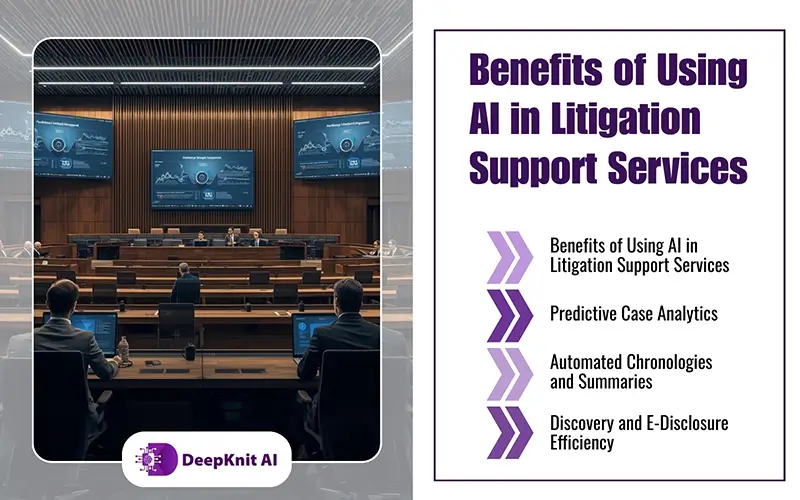
Benefits of Using AI in Litigation Support Services
When disputes arise, especially with medical records, liability or settlements, litigation support teams step in to take care of business. Here’s where AI in legal support can augment the team’s role to the next level. Let’s see how.
- Intelligent Document Review
Litigation often means dealing with massive datasets, from case files and depositions to medical histories and expert opinions.
AI-powered review systems automatically categorize and tag these documents, identify critical evidence, and extract relevant insights for attorneys and insurance adjusters.
For example, legal AI software can pinpoint inconsistencies between a claimant’s reported injuries and medical notes, a task that could take paralegals days or weeks to complete.
DeepKnit AI is well-trained in medical document understanding, using advanced NLP to read and interpret physician notes, diagnoses, and clinical terms, thereby converting them into structured, litigation-ready summaries.
- Predictive Case Analytics
AI doesn’t just process information, it learns from it.
By analyzing historical case data, verdict outcomes, and legal arguments, predictive models can forecast case trajectories, possible settlement ranges, or even the likelihood of success in court.
This allows legal teams and insurers to make informed, data-driven decisions early in the process, which often leads to faster resolutions and reduced legal costs.
- Automated Chronologies and Summaries
In personal injury and workers’ compensation cases, constructing accurate medical chronologies is critical.
AI systems can automatically extract event timelines from medical records, identify cause-and-effect relationships, and generate narrative summaries that make complex data understandable at a glance.
This saves countless hours of manual review and minimizes human oversight errors, making litigation preparation both faster and more precise.
- Discovery and E-Disclosure Efficiency
The discovery phase in litigation is one of the most resource-intensive stages. AI tools can search through terabytes of emails, reports, and messages to locate relevant documents.
Advanced semantic search models understand context, and not just keywords, enabling teams to uncover hidden insights and evidence connections that would otherwise go unnoticed.
AI’s Role in Insurance-related Legal Collaboration
AI also serves as the bridge between insurance teams and legal professionals, aligning their workflows and ensuring data consistency.
For example:
- Insurers use AI tools to identify potential litigation risks in claims data early.
- Legal teams use the same systems to gather supporting evidence and validate medical findings.
- Both sides gain a unified, data-driven understanding of the case.
This synergy reduces communication gaps, accelerates decision-making, and leads to better outcomes for both clients and carriers.
Why Intelligent Automation Matters More Than Ever
The insurance and litigation sectors are no strangers to transformation. But the AI-driven evolution stands apart because it fundamentally changes the way decisions are made.
We’re no longer talking about replacing human judgment but enhancing it.
With intelligent, AI-powered platforms, professionals gain a smart assistant that:
- Understands medical and legal language fluently
- Summarizes complex documents with precision
- Flags discrepancies across datasets
- Provides insights that empower faster, fairer resolutions
As data volumes explode and case complexity deepens, the firms that adopt AI early will lead with agility, while others play catch-up.
AI also helps legal and insurance professionals prepare Medicare Set-Asides by organizing complex medical records and supporting compliance. Learn more in Preparing Medicare Set-Asides with AI: A Legal Advantage.
Final Thoughts
The convergence of AI, insurance, and litigation support represents one of the most exciting frontiers in professional services today.
It’s no longer about merely managing data; it’s about understanding it faster, deeper, and smarter. AI equips insurers to minimize fraud and improve customer trust. It empowers litigators to uncover truth in complexity. And it creates a new era of collaboration; one where technology and expertise merge seamlessly.
As industries evolve, the question isn’t “Should we use AI?” anymore. It’s “How fast can we adapt, and who do we trust to guide us?”
If you’re ready to transform your insurance or litigation operations with smarter, data-driven solutions, it’s time to connect with DeepKnit AI where intelligence meets insight, and every decision starts with understanding.
Reimagine Litigation Support with AI-driven Clarity and Precision